Does TeleCBIT work?
Community Summary of: Evaluating the feasibility, acceptability, and preliminary effectiveness of tele-comprehensive behavior therapy for tics (teleCBIT) for Tourette syndrome in youth and adults
Authors of the article in the Journal of Telemed Telecare: Matthew R Capriotti, Brianna Wellen PhD, Brianna N Young, Michael B Himle, Christine Conelea PhD, Flint M Espil, Heather Simpson, Carol A Mathews
Published online: 7 August 2023
Community summary posted on March 12, 2025
Word count: 476 (4 min)
Reading level: 7th grade
Read the full article (subscription required):
Why does this study matter?
Many people living with Tourette syndrome (TS) have used a specific type of therapy called CBIT. CBIT (Comprehensive Behavioral Intervention for Tics) can help make living with tics easier. CBIT is a non-drug therapy that helps patients and their families learn ways to manage tics. CBIT can be empowering for patients because it focuses on teaching patients new skills so they can make choices about managing tics on their own terms.
However, CBIT therapists may not be located near people who need them. There aren’t enough therapists for all of the people who would like to try CBIT.
Doing video CBIT therapy (teleCBIT) might help these problems. Video therapy has been studied and shown to be possible to do and effective for many people seeking therapy for different challenges. But the research on teleCBIT had only been done with young people, and it used forms of technology that are now a bit dated. We need more information about whether teleCBIT can help youth and adults. We also need to know more about how best to do it.
What happened?
Our research team worked with a state-of-the-art clinic that provided CBIT, medication, and other treatments for TS. From October 2016 to September 2018. Patients at these clinics were offered teleCBIT at their appointments. Eligible people received 8 sessions. A professional who did not know the therapists or the patients gave the patients surveys and asked them questions about their tics before and after these 8 sessions. They also repeated the surveys and other questions 3 and 6 months after that. Experts also checked video recordings of some of the sessions to ensure they were done correctly.
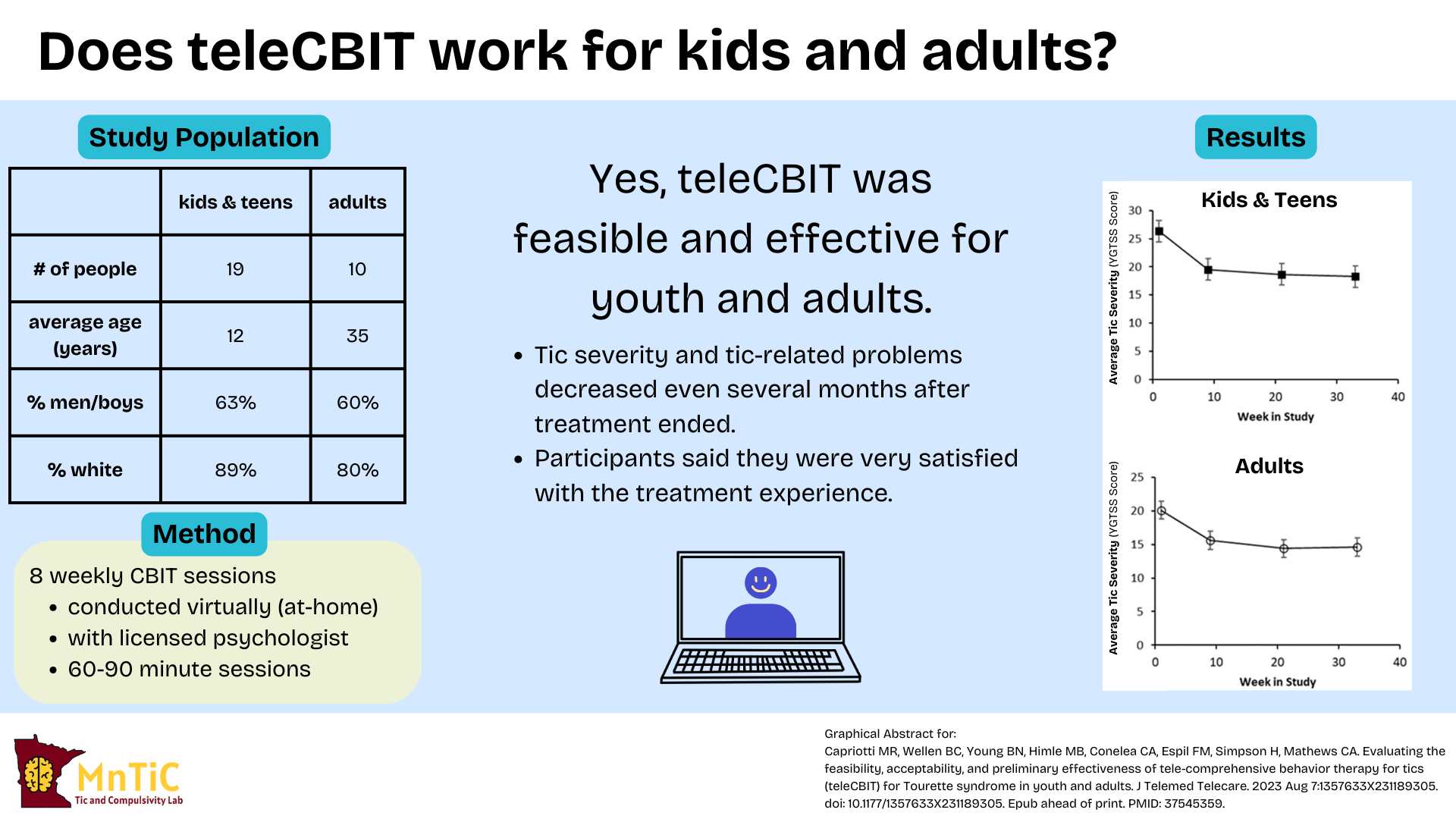
Nineteen children and 10 adults participated. All of the people who signed up finished the sessions. Our team measured tic severity using a scale that many people trust called the Yale Global Tic Severity Scale.
What did our research team learn?
These video CBIT sessions were highly effective, with several positive outcomes. Ninety-three percent of sessions had no significant technical problems. Patients and parents said they were “highly satisfied” with the therapy experience. The children’s tic severity decreased (a large change) which means they felt that their tics were affecting them less after the sessions. The adults’ tic severity also decreased (a medium to large change), but slightly less than the children’s. Thirteen of the children (68%) and 6 of the adults (60%) had a positive change, even 3 and 6 months after the sessions.
What can our research team do next?
We still have a lot of questions about how to use teleCBIT. We want to look at how to train CBIT therapists better. We also want to know more about who CBIT works best for and why. Our team has several CBIT studies happening now.
How can you find out more?
Read the full article